
If you run a local business, you have probably noticed something changing in the way your customers find you. A few years ago, people typed a question into Google, scrolled through a list of blue links, and clicked the one that looked right. Today more and more of them are asking ChatGPT, Perplexity, Gemini, or Google’s AI Overview for a recommendation, and they are trusting the answer they get back.
I have been in the SEO industry for the last seven to eight years, and over the past two years I have seen two terms pop up again and again, often used as if they mean the same thing: GEO and AEO. They are related, but they are not identical, and understanding the difference can help you make smarter decisions about where to spend your time and money.
In this article I am going to walk you through what each of these terms actually means, which one matters more for a local business like yours, and the practical steps you can take to show up when someone asks an AI tool for a recommendation. I am also going to share a simple trick I have been using successfully for the last two years, which has helped my clients rank at the top on traditional search as well as on AI engines.
What Is GEO (Generative Engine Optimization)?
Generative Engine Optimization, or GEO, is the practice of optimizing your online presence so that generative AI tools pick up your business and weave it into the answers they generate. Think of tools like ChatGPT, Perplexity, Google’s Gemini, and Google AI Overviews. When someone asks one of these tools a question, it does not just hand back a list of links. It writes an answer in its own words, pulling from many sources across the web.
GEO is about making sure your business is one of those sources. It looks at the bigger picture of how often your brand is mentioned around the web, how trustworthy those mentions are, and how clearly your information is presented so that an AI model feels confident recommending you. In short, GEO is about building a reputation that AI tools trust enough to repeat.
What Is AEO (Answer Engine Optimization)?
Answer Engine Optimization, or AEO, is a closely related idea with a slightly narrower focus. An answer engine is any tool that gives a person a direct answer rather than a page of results. That includes AI chatbots, but it also includes things like voice assistants and the featured answer boxes you see at the top of a Google search.
AEO is about structuring your content so that it can be lifted cleanly and used as the answer to a specific question. If someone asks, “How long does Invisalign take?” or “Do chiropractors treat sciatica?”, AEO is what helps your clear, well organized answer become the response that gets read aloud or displayed at the top. The focus here is on being clear, direct, and easy for a machine to understand.
For example:
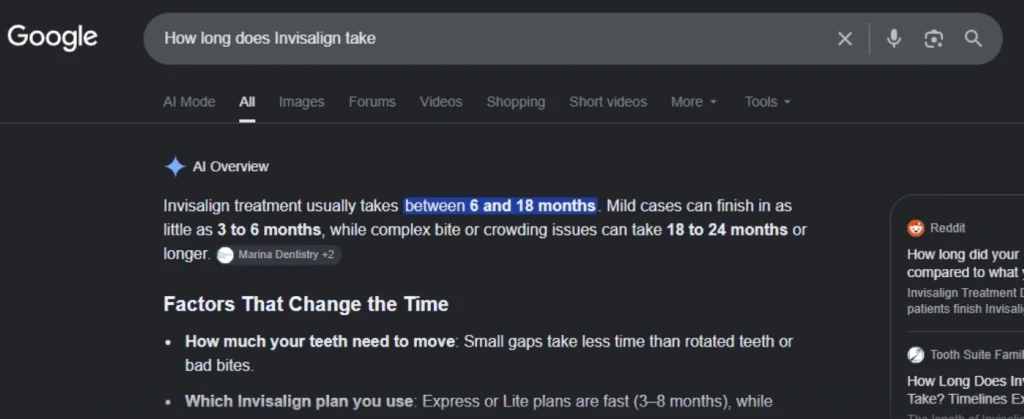
Here is a simple way to hold both ideas in your head. AEO is about giving the best, clearest answer to a specific question. GEO is about building enough trust and presence across the web that AI tools choose to mention you in the first place. You really want both working together.
What’s More Relevant for Local Business Owners?
If you run a clinic or a local service business, the honest answer is that you need a bit of both, but they serve different goals.
AEO tends to help you with the questions people ask before they are ready to book. Things like “Does teeth whitening hurt?” or “How often should I see a physiotherapist?” These are informational questions, and answering them well builds trust with people who might become patients later.
GEO tends to matter more for the questions that are close to a decision, such as “What is the best dental clinic near me?” or “Suggest a good medical spa in my city.” These are the questions where you really want to be the name that the AI brings up, because the person asking is often getting close to picking someone.
For most local business owners I work with, GEO ends up being the one that moves the needle on revenue, because it is tied so closely to “recommend me a business” searches. That said, AEO is what builds the credibility underneath, and the two support each other. My advice is not to choose one and ignore the other. Start with the foundations that serve both, and then lean into GEO when you want to capture buying intent.
How to Optimize for AEO
Optimizing for answer engines is less about tricks and more about clarity. You are trying to make your content so easy to understand that a machine can pick out your answer without guesswork. Here are the things I focus on.
- Answer real questions directly. List out the questions your customers actually ask and answer each one in plain language. Put the short, clear answer first, then add the detail underneath. If someone asks how long a procedure takes, open with the time frame, then explain the details. The best way to do this is through blogs on the website.
- Use a clear question and answer structure. A well organized FAQ section is one of the most reliable ways to feed answer engines. Use the actual question as a heading, then give a tight answer just below it.
- Keep your language simple. Short sentences and everyday words are easier for both people and machines to follow. You do not need to sound clever. You need to sound clear.
- Add structured data. Schema markup is a small piece of code that tells search engines what your content is. FAQ schema, local business schema, and service schema all help answer engines understand your pages with less effort. If you are not technical, this is one area where a little help goes a long way.
- Keep your core facts consistent. Your name, address, phone number, hours, and services should match everywhere they appear. When these details conflict across different sites, answer engines get less confident about using you.
How to Optimize for GEO
Optimizing for generative engines is about building a reputation that AI tools run into again and again. You want your business to show up in enough trusted places that the AI starts to treat you as a natural answer. Here is how I approach it.
- Earn mentions on the sites AI already trusts. When an AI tool recommends local businesses, it often pulls from third party sites that list or review businesses in your category. Getting your business mentioned on those sites is one of the strongest things you can do. I will show you exactly how to find them in the next section.
- Build and maintain strong reviews. Reviews are one of the clearest signals of trust, and AI tools pay attention to both the number and the quality of them. A steady flow of genuine reviews on your Google Business Profile and other platforms helps a lot.
- Keep your Google Business Profile complete and accurate. Fill in every field. Categories, services, hours, photos, and your service area all give AI tools clean information to work with.
- Say clearly who you serve and where. Make your city, your neighborhoods, and your specific services obvious on your website. Do not make an AI tool guess whether you serve their area. Spell it out.
- Publish content that shows real expertise. Helpful, honest content that answers real questions signals that you know your field. Over time this builds the kind of authority that generative engines reward.
How I Helped a Local Orthodontic Clinic in Calgary Rank on AI Engines Like ChatGPT
I want to share a real example, because this is the trick I mentioned at the start, and it is the part that has worked the best for my clients over the last two years.
I worked on the SEO and AEO for a local orthodontic clinic based in Calgary. When I started, they were not ranking well on AI platforms like ChatGPT. Within six months they started performing well and were showing up around the third position for a majority of their commercial keywords. Here is the strategy I followed.
Step one: I identified the real questions people ask. I started by writing out five different types of search queries that people actually use when they ask ChatGPT for a recommendation. For example:
- Best orthodontic clinic in Calgary
- Suggest me the best orthodontic clinic in Calgary for braces
- I live in Calgary, tell me an orthodontic clinic I should go to for Invisalign
Queries like these cover a vast majority of what matters to the client: the target location, the target customer, and the specific services they offer.
Step two: I noted which websites the AI was pulling from. Every time I searched one of those queries, I wrote down which websites ChatGPT was using to pull its information from. Most of the time these were third party sites or citations, the kind that publish lists of the best orthodontic clinics in the city.
Step three: I made those sites part of the strategy. I included those third party websites in the SEO plan for the client, and over the next three months the aim was to earn backlinks and mentions from them. If those are the sources the AI trusts, then getting your business onto them is one of the most direct ways to get recommended.
Step four: I looked at why the AI was recommending certain businesses. Along the way, I also noted what factors ChatGPT seemed to use when it recommended a clinic. These included:
- the number of reviews
- the distance
- the location of the clinic
- the services it covered
Step five: I made sure those factors were front and center. Once I knew what the AI cared about, I made sure those things were clearly mentioned and well promoted throughout the website. The services, the location, and the reviews were all easy to find and impossible to miss.
This is the heart of the strategy. You use the data that the AI tools themselves show you, and then you put that data to work for your business. Since then I have used the same approach for multiple businesses, and I have seen growth in a comparatively shorter amount of time.
Bringing It All Together
GEO and AEO are not magic, and they are not something to be intimidated by. At their core, both are about the same old fundamentals that have always mattered: be clear about who you are, be easy to understand, earn genuine trust, and show up in the places your customers are looking. The tools have changed, but the principles have not.
If you are a local business owner and you are not sure where to start, begin with the simple things. Make sure your core facts are consistent everywhere, keep your Google Business Profile complete, answer real questions on your website, and find out which trusted sites the AI tools are already pulling from. That last step alone can teach you more about your market than almost anything else, and it costs you nothing but a little time.
Start small, stay consistent, and give it a few months. The businesses that show up on AI search tomorrow are the ones doing this quiet groundwork today.
FAQs related to AEO and GEO for Local Businesses
No. Unlike traditional ads, you cannot buy your way into AI recommendations. These tools pull from trusted sources across the web, so your visibility comes from reputation, reviews, and genuine mentions rather than any paid placement.
The time usually depends on where you are at now with your website and content optimization. If your business has been there for long and reputed well in the local community, it takes around 3 months to rank on AI search engines. If you are starting a new business, it takes up to a year to start showing up on AI engines.
Yes, they can. AI engines often pull from different sources than a standard Google ranking, so a competitor with more reviews or better third party mentions may get suggested. This is why AI visibility deserves its own attention.
Simply ask. Type the kinds of questions your customers would use, such as “best dentist near me,” and see whether your business appears. Do this every few weeks to track your progress and spot new opportunities.
Both matter. While your Google Business Profile carries a lot of weight, AI tools also look at reviews and mentions on other trusted sites. A healthy presence across several platforms builds stronger trust and a wider footprint.
Yes, and often more so. Smaller businesses can move faster and target very specific local queries where big brands pay less attention. A little consistent effort here can help you stand out in your city without a large budget.
Not quite. SEO focuses on ranking your pages in traditional search results, while AEO and GEO focus on being chosen as the answer inside AI tools. AEO and GEO is like a layer above SEO.