You have a decent number of positive reviews on your Google Business Profile, a great website, and regularly updated social media profiles, yet ChatGPT still is not recommending your dental clinic. If this sounds familiar, you are in the right place. In this guide, I am going to share a few simple strategies to help your dental clinic become one of the top recommendations offered by ChatGPT and other LLMs like Gemini, Claude, and Perplexity.
Before you read further, it helps to have the following foundations already in place:
- A user-friendly, SEO-optimized website
- A well-optimized Google Business Profile
- Other social media profiles, such as Facebook and Instagram
If you would like a hand with website and Google Business Profile optimization, please feel free to schedule a growth call with me using the link below.
Alright, now we are all set to walk through a few GEO (Generative Engine Optimization) strategies that can help your dental clinic get recommended by ChatGPT.
1. Analyze the Results ChatGPT Gives When You Search “Best Dental Clinic in Your City”
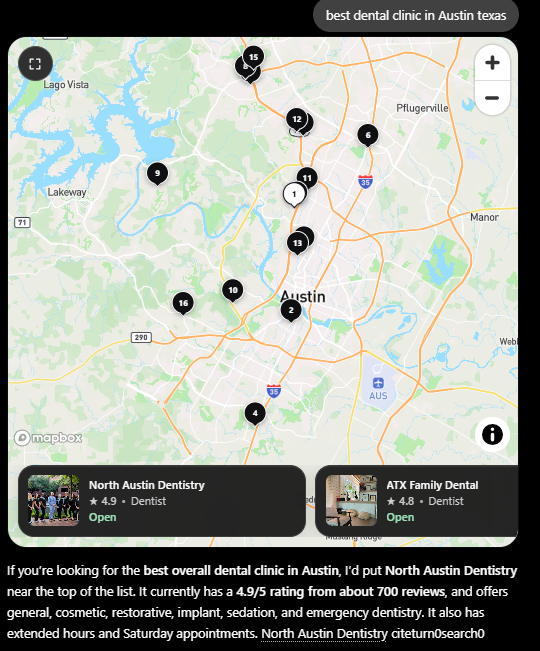
The best starting point is to see what the AI already thinks. Open ChatGPT and search for something like “Best dental clinic in [your city]” or “Best dentist in [your city].” This shows you exactly which clinics are being named and, just as importantly, why.
A couple of pointers to keep this accurate:
- Use a private window or incognito mode so your own browsing history and location do not skew the results.
- Look closely at the sources the AI cites and the reasons it gives for recommending those businesses. Then ask a follow-up question, such as “Why did you recommend only these clinics and not other clinics in the area?”
The follow-up answer is where the real insight lives. ChatGPT will often tell you it favored a clinic because of its higher review count, its listing on a trusted directory, or the clear service information on its website.
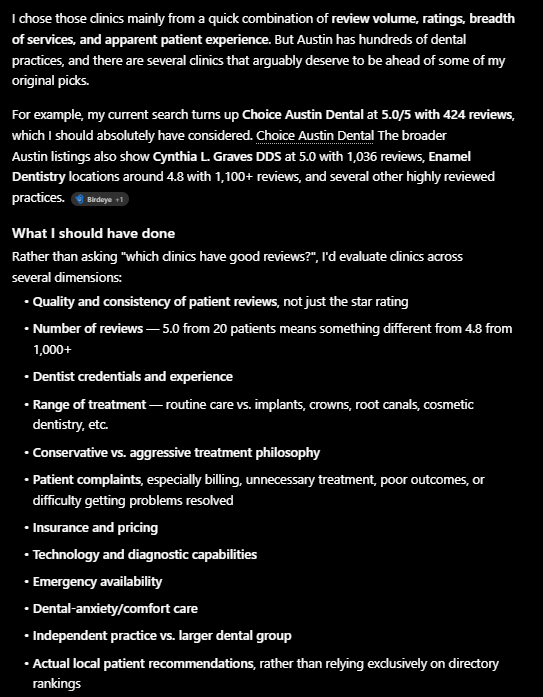
Example: A dental clinic in Austin ran this search and found that ChatGPT kept naming five to six competitors.
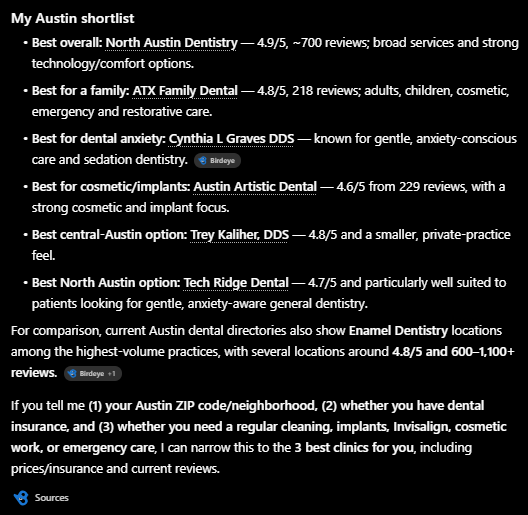
When the owner asked “Why are you recommending these clinics and not other clinics in the area”, ChatGPT pointed out that it chose those clinics mainly from a quick combination of review volume, ratings, breadth of services, and apparent patient experience.
2. Build Backlinks and Citations From the Most Trusted Sources ChatGPT Relies On
Look back at what ChatGPT cited for our Austin clinic. Its shortlist was pulled together from review platforms and directories such as Birdeye, along with broader Austin dental listings. Those are the neutral, third-party sources it trusted to decide who belonged on the list. Your job is to make sure your clinic has a strong, accurate, and consistent presence on those same sources.
AI assistants cross-reference multiple places before naming a business, so appearing consistently on the platforms they read builds the confidence they need to recommend you. For dental clinics, the sources that tend to carry weight include:
- Healthcare-specific directories such as Healthgrades, Zocdoc, and Vitals
- Well-known review and listing platforms like Birdeye, Yelp, and your Google Business Profile
- Local and regional publications, dental association pages, and community “best of” lists
Aim to keep your name, address, phone number, hours, and services identical everywhere. Inconsistency reads as unreliability to an AI system and can quietly drop you from consideration.
Back to our Austin example: Notice that ChatGPT surfaced Choice Austin Dental (5.0 from 424 reviews) only when pushed, and admitted it had overlooked the clinic at first. A likely reason is that its presence across the trusted directories was thinner or less consistent than the clinics that made the initial list. If Choice Austin Dental wanted to fix this, the move would be to claim and align its listings on Birdeye, Healthgrades, and the main Austin dental directories, so that the next time ChatGPT scans those sources, the clinic is impossible to miss.
3. Make Sure Every Criterion ChatGPT Uses Is Implemented Well On Your Website
In step one, ChatGPT literally spelled out the criteria it uses to judge dental clinics. Now it is time to make sure your website and profiles satisfy each of those criteria clearly and honestly. AI assistants lean heavily on trust signals, so the more of them you can genuinely display, the better.
Using the Austin scorecard as our checklist, focus on strengthening signals like these:
- Positive, recent reviews with substance: ChatGPT cared about review quality and consistency, not just the star number. Encourage happy patients to leave detailed reviews shortly after their visit so your rating stays current and credible.
- Dentist credentials and experience: This was on ChatGPT’s list by name. Display your dentists’ qualifications, years of experience, professional memberships, and licenses.
- Clear range of treatment: ChatGPT distinguished routine care from implants, crowns, root canals, and cosmetic work. Make each service unmistakably clear on its own page.
- Comfort care, emergency availability, insurance, and pricing: Every one of these appeared in ChatGPT’s “what I should have done” list, so state them plainly on your site.
Think of it this way. ChatGPT told our Austin clinic exactly what a well-rounded dental practice looks like in its eyes. Your website should make each of those points easy to find at a glance.
Applied to Austin: Recall that ChatGPT initially favored North Austin Dentistry partly because it clearly offered “general, cosmetic, restorative, implant, sedation, and emergency dentistry” with extended hours and Saturday appointments. That breadth was easy for the AI to read and repeat. A competitor wanting the same treatment would make sure its own site listed that full range of services, its sedation and comfort options, and its emergency and weekend availability just as clearly.
4. Boost the Topical Authority of Your Services Through a Blog and FAQ Content Hub
AI assistants tend to recommend businesses that clearly demonstrate expertise in their specialty. One of the most reliable ways to build that expertise in the eyes of an LLM is to publish helpful, well-organized content that answers the real questions your patients ask.
Here again, the Austin scorecard points the way. ChatGPT singled out categories like “best for dental anxiety” and “best for cosmetic and implants.” Those categories are content opportunities. A focused content hub works better than scattered posts, so consider building out:
- Service-specific pages that go deep on your main treatments, such as dental implants, Invisalign, teeth whitening, or root canals
- Blog posts that answer common patient questions, like “How long does a dental implant last?” or “What are my options if I have dental anxiety?”
- A well-structured FAQ section with clear, self-contained answers that an AI can easily quote
The goal is to become the clearest, most helpful source of information for your specialty in your area. When you cover your niche thoroughly, AI systems are more likely to view you as an authority worth citing.
ChatGPT labeled one clinic “best for dental anxiety” and another “best for cosmetic and implants.” If our example clinic wants to own the anxiety-conscious category, it could publish a genuinely helpful hub around sedation dentistry, what to expect during a gentle visit, and how the team supports nervous patients. Over time, that depth signals to ChatGPT that the clinic is a natural fit whenever someone asks for an anxiety-aware dentist in Austin.
5. Add an llms.txt File (With Realistic Expectations)
An llms.txt file is a simple text file placed at the root of your website that gives AI systems a tidy summary of your site and links to your most important pages. Adding one is a low-effort, low-risk step, and it can help AI agents understand your site’s structure more easily.
It is worth being straightforward here, because I would rather set the right expectation than oversell a tactic. At the moment, the evidence that llms.txt directly increases AI recommendations is mixed, and the major AI providers have not confirmed they rely on it to decide citations. So please think of it as a helpful piece of good housekeeping rather than a shortcut. The real work still lives in reviews, trusted citations, and genuinely useful content.
A basic llms.txt for a dental clinic might list your homepage, your key service pages, your location page, and your contact page, each with a short description.
For our Austin clinic, a tidy llms.txt would point clearly to its implant page, its sedation and comfort care page, its emergency dentistry page, and its Austin location and contact pages, each with a one-line description. It will not replace the work in the sections above, but it makes the clinic’s most important pages, the very ones tied to ChatGPT’s criteria, easy for AI agents to locate and parse.
6. Add Optimized Schema Markup To All Your Webpages
Schema markup is structured code that helps search engines and AI systems understand exactly what your page is about. For a dental clinic, the right schema makes your key details, such as services, location, hours, and reviews, easy to read and trust.
The schema types most useful for dental clinics include:
- Dentist or MedicalBusiness schema: to describe your practice, address, phone number, and hours
- Service schema: to clearly define each treatment you offer
- FAQPage schema: to mark up your FAQ answers so they can be surfaced cleanly
- Review or AggregateRating schema: to present your review signals in a structured way
Well-implemented schema will not carry your clinic on its own, but paired with strong content and trust signals it helps AI systems extract your information accurately and place you in the right answers.
Key Takeaways
Getting recommended by ChatGPT is not about any single trick, and the Austin example shows why. In one honest answer, ChatGPT laid out the review quality, breadth of services, credentials, comfort care, and trusted sources it uses to decide who to name. Every strategy in this guide is simply a way of meeting that scorecard: understand what ChatGPT already values, strengthen your presence on the sources it relies on, satisfy its criteria on your own site, build genuine topical authority, and support it all with clean technical foundations like llms.txt and schema markup.
Work through these steps steadily over the next few months and you will build the kind of durable visibility that keeps your clinic showing up in AI recommendations. If you would like a partner to help you get there, I would be glad to walk through it with you on a quick growth call.
Frequently Asked Questions
AI systems draw on reviews, citations, and content that build up gradually, most clinics see meaningful movement over a period of roughly six months of consistent effort. The pace depends on how competitive your city is and how strong your starting point is. Steady, honest work tends to compound, so the clinics that keep going usually see the clearest results.
No, there is currently no paid placement that guarantees an AI assistant will recommend your clinic. Recommendations are earned through genuine trust signals like reviews, accurate listings, and helpful content rather than bought. This is actually good news for smaller, high-quality clinics, because it means you can compete on the strength of your reputation and your content rather than on ad budget alone.
Reviews are one of the heaviest factors, but they are not the whole picture on their own. As our Austin example showed, ChatGPT weighs review quality and consistency alongside the raw star rating, and it cross-references your reviews with your website content and directory listings. A clinic with strong reviews and clear, consistent information everywhere will generally do better than one that has reviews alone. Think of reviews as a powerful ingredient rather than the entire recipe.
They share a lot of common ground, since all of them favor businesses that are well-reviewed, consistently listed, and clearly described. That said, each assistant pulls from a slightly different mix of sources, so results can vary between them. The reassuring part is that the core work in this guide, such as strong reviews, trusted citations, and helpful content, helps you across all of them rather than just one.
You are right that results can shift from one search to the next, since these systems pull fresh information and phrase things differently each time. Rather than chasing any single answer, it helps to run the search a few times over a few weeks and look for patterns in which clinics and criteria keep appearing.